TechnologyFrontendBackend
Frontend vs Backend Development: The Ultimate Power Guide for Modern Web Developers (2025)
M. Fadil Martias
4 min read•Dec 16
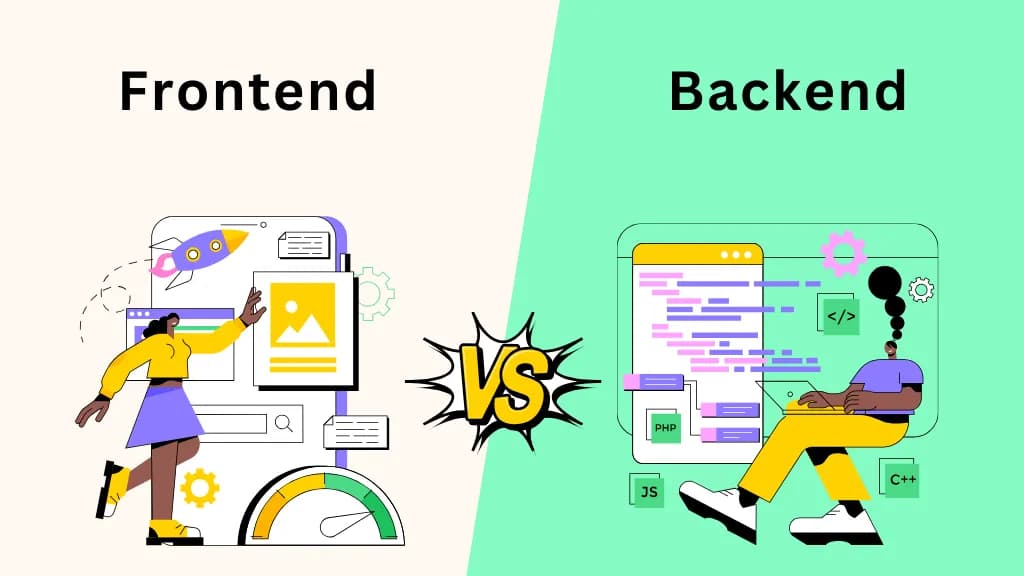
Frontend vs backend development is one of the most common comparisons in web programming. Both roles are essential, and together they power everything you see and use on the web.
At a high level, frontend development focuses on what users see and interact with, while backend development handles logic, databases, servers, and performance behind the scenes. Think of a restaurant: the frontend is the dining area and menu, while the backend is the kitchen and supply system.
Understanding this difference helps beginners choose a learning path and helps professionals collaborate better on complex projects.
Frontend development deals with the client-side of web applications. It focuses on layout, design, responsiveness, and user interaction.
Frontend developers turn designs into real interfaces using code. Their goal is to create fast, accessible, and visually appealing experiences across devices.
Key goals:
Smooth user experience (UX)
Responsive layouts
Accessibility and performance
Cross-browser compatibility
Backend development handles the server-side logic of an application. It ensures data flows correctly between the database and the frontend.
Backend developers build APIs, manage authentication, optimize databases, and ensure security. Without backend systems, frontend interfaces would have nothing to display or process.
Key goals:
Data integrity and security
Scalability and performance
Business logic implementation
API reliability
Build UI components
Implement responsive design
Optimize page speed
Consume APIs
Handle browser compatibility
Improve accessibility (WCAG)
Design databases
Build REST or GraphQL APIs
Handle authentication & authorization
Optimize server performance
Manage cloud infrastructure
Ensure application security
HTML, CSS, JavaScript
React, Vue, Angular
Tailwind CSS, Bootstrap
Vite, Webpack
Git, npm, Yarn
JavaScript (Node.js)
Python (Django, FastAPI)
PHP (Laravel)
Java (Spring Boot)
Databases: MySQL, PostgreSQL, MongoDB
Cloud: AWS, Docker, Kubernetes
Strong JavaScript fundamentals
UI/UX awareness
Responsive design principles
State management
Performance optimization
Data modeling
API design
Security best practices
Server optimization
System architecture
Beginners often ask where to start. If you enjoy visuals, design, and instant feedback, frontend development may feel more rewarding. If you enjoy logic, data, and problem-solving, backend development may be a better fit.
Many developers start with frontend because results are visible quickly. Others prefer backend for its structured and analytical nature.
Both paths offer strong career growth:
Frontend Developer
Backend Developer
Full-Stack Developer
Software Architect
DevOps Engineer
Salaries depend on experience, region, and stack, but backend and full-stack roles often command slightly higher pay due to system complexity.
Full-stack developers work across frontend vs backend development. They understand the entire system, making them valuable in startups and agile teams.
However, full-stack mastery takes time. It’s often best to specialize first, then expand.
E-commerce: Frontend handles product display; backend manages payments and inventory
Social media: Frontend renders feeds; backend handles user data and algorithms
SaaS apps: Frontend dashboards; backend analytics and billing
1. Is frontend easier than backend development?
Frontend feels easier initially, but both become complex at advanced levels.
2. Can I learn both frontend and backend?
Yes, many developers become full-stack over time.
3. Which is better for beginners?
Frontend is often recommended for beginners.
4. Do I need math for backend development?
Basic logic is enough; advanced math is rarely required.
5. Is frontend development dying?
No, frontend is evolving rapidly with new frameworks.
6. Which pays more: frontend vs backend development?
Backend and full-stack roles often pay slightly more.
Choosing between frontend vs backend development depends on your interests, strengths, and career goals. Both are essential, in-demand, and rewarding. Start where you feel most comfortable—and grow from there.